
BLOG
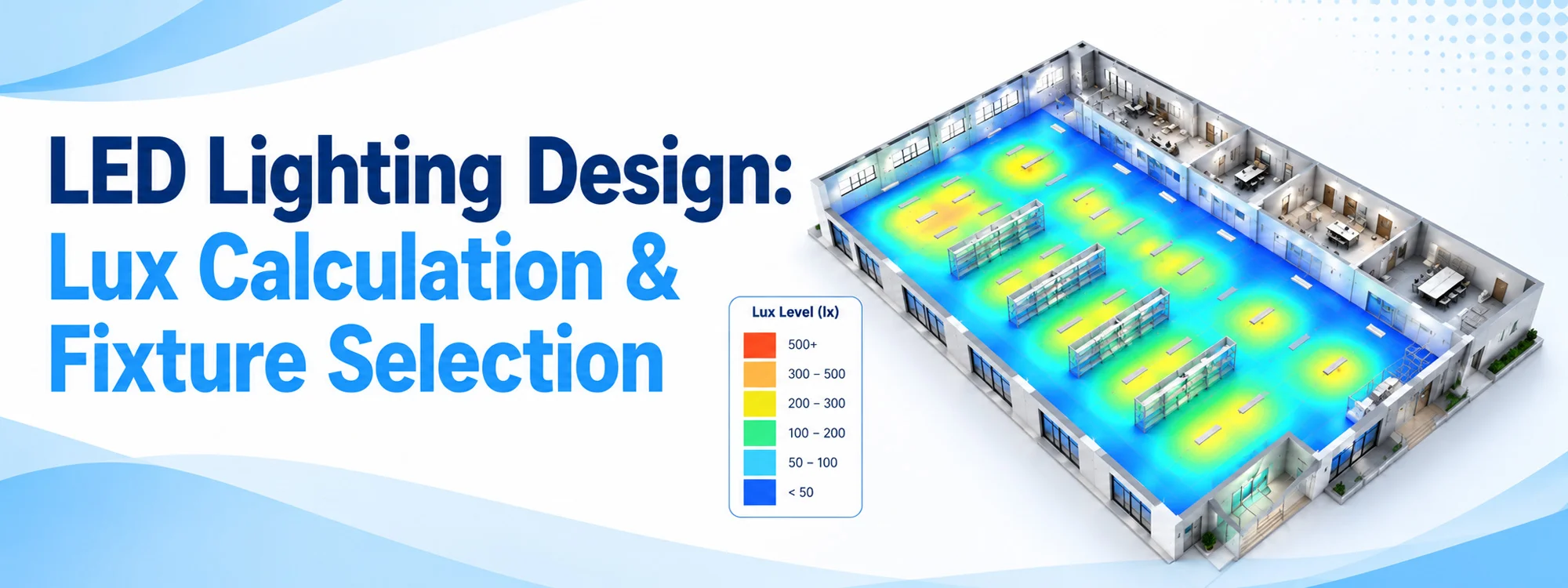
LED Lighting Design: Lux Calculation & Fixture Selection
Pyrotech Technologies is an Indian-based LED lighting company that offers application-driven lighting solutions to EPC contractors, consultants, and project managers of various industrial projects. The company provides a wide array of LED lighting solutions for industrial, commercial, infrastructure, warehouse, power generation, and oil and gas industries. Pyrotech designs lighting solutions taking into account factors such as the need for illumination, energy savings, mounting conditions, and operating conditions of the particular project.
What Is Lux in LED Lighting?
Lux is the unit of measurement for illuminance and refers to the quantity of visible light reaching a surface area. One lux is the equivalent of one lumen spread over a surface area of one square metre. While lumens are used to indicate the amount of light generated by an LED luminaire, the lux value is employed to measure the amount of light falling on a given surface area from that luminaire. The lux value generated by the same luminaire varies based on a number of design considerations.
Why Is Lux Calculation Important in Lighting Design?
Lux calculation helps designers estimate whether the planned lighting system can provide the required illuminance for the intended working area. Lux calculations help estimate the required lumen output and preliminary number of luminaires needed to achieve the target illuminance.
How to Calculate Lux for LED Lighting?
Lux calculations can be done through the formula:
Average Lux level = Total Lumens Produced ÷ Areas
In terms of actual design for LED lighting, the lumen method takes into consideration the factors of utilisation and maintenance. The calculation for the fixture quantity is given by:
Number of LED Fixtures = (Required Lux Level × Area/Size) ÷ (Lumens produced in every fixture × Utilization Factor × Maintenance Factor)
Required lux is the target illuminance for the application, area is the surface to be illuminated, and lumens per fixture is the light output of one luminaire. The utilisation factor refers to the percentage of the lumens reaching the working plane, whereas the maintenance factor refers to the percentage decrease in the level of illumination.
For example, an area of 200 m² required 300 lux, using a 15,000-lumen luminaire with a utilisation factor of 0.8 and maintenance factor of 0.8, gives approximately 6.25 fixtures, which should be rounded up to 7 fixtures. This lumen-method calculation provides a preliminary fixture estimate, the final quantity, spacing, and uniformity should be verified using photometric data and lighting simulation.
Parameters Influencing LED Lighting Design
Several factors influence the performance and effectiveness of an LED lighting design:
How to Select the Right LED Fixture
LED Fixture Selection by Application
LED luminaires should be selected according to the application, required illuminance, mounting conditions, environment, and photometric requirements rather than wattage alone. The following are common LED fixture types used for various applications.
The final choice must consider such things as lux level, installation height, environment, and maintenance.

Frequently Asked Questions (FAQs)
1. What happens if an industrial area has insufficient lighting?
Insufficient lux can reduce visibility, increase shadows, and make industrial tasks difficult. Selecting an appropriate lux level improves visibility and working conditions.
2. What lux level is suitable for a cement plant control room?
A typical reference range may be around 300–500 lux for a cement plant control room, depending on the visual task, layout, applicable requirements, and project specifications.
3. What lux level can improve visibility in a warehouse?
A typical reference range of 100–200 lux may be considered for warehouse and bulk-storage areas, depending on the visual task, storage arrangement, and applicable requirements.
4. What lux level is suitable for detailed inspection work?
Detailed inspection tasks generally require higher illuminance. Values around 750–1000 lux may be appropriate for some fine inspection and assembly applications, depending on the visual task and applicable requirements.
5. How can poor lighting uniformity be addressed?
Designing for suitable average lux while maintaining adequate uniformity can reduce excessively bright and dark areas across the working surface.
CONTACT US
TALK TO EXPERT
Talk to our expert for industrial solutions, customised according to your specific requirements

CATALOGUES DOWNLOAD
PRODUCTS


